Boryna’s land settlement
The PeasantsBoryna’s land settlement is the agreement transferring six morgen of land to Jagna in anticipation of her marriage to Boryna. More than a document, it becomes the focal point of a family dispute over who may claim the land and on what authority: Antek regards the grant as a threat to his household, while the settlement’s uncertain status gives his allies a chance to argue that Boryna’s decision can still be contested.
The six-morgen grant and its limits
The immediate grievance is the scale and destination of the transfer. Antek protests that he and Hanka work like farmhands while Boryna gives six morgen to a stranger. The settlement has already been made, and Boryna is preparing to marry Jagna, but the grant does not, in the advice Antek receives, settle the future of all the family land. The Blacksmith’s Wife insists that Boryna can withdraw the arrangement while he is alive. That qualification makes the document a source of both alarm and opportunity: it marks a present decision, but not necessarily an irreversible one.
The conversation also introduces a separate claim about land Boryna received from Antek’s mother. The Blacksmith’s Wife presents this origin as a possible point of legal challenge, arguing that the land has been sown and reaped by Boryna for years without being given to Antek or Hanka. She frames that history as grounds to demand payment, potentially with interest. The evidence does not establish that a court accepts this reasoning; it establishes that the settlement’s family history can be turned into an argument against Boryna’s unrestricted control.
A strategy of appearances and witnesses
The Blacksmith’s Wife advises Antek not to confront Boryna openly. Instead, he should praise the marriage decision, attend the wedding, and maintain goodwill while securing a promise about the rest of the land—his and Hanka’s—before witnesses. In her plan, the public appearance of agreement is tactical: a witnessed promise would give the family something firmer to hold onto than an angry dispute conducted in private. If persuasion fails, she proposes the courts as a further recourse.
Her approach depends on separating the six-morgen settlement from the unresolved claims to other land. She does not tell Antek that the grant can simply be ignored. Rather, she urges him to let Boryna proceed with the wedding while trying to obtain a commitment that protects the younger household. She also suggests that Jagna might influence Boryna, since he thinks highly of her. The settlement thus draws several people into a contest over leverage: Boryna controls the decision for the moment, Antek is urged to seek enforceable assurances, and Jagna is imagined as someone who may be able to affect the old man’s choices.
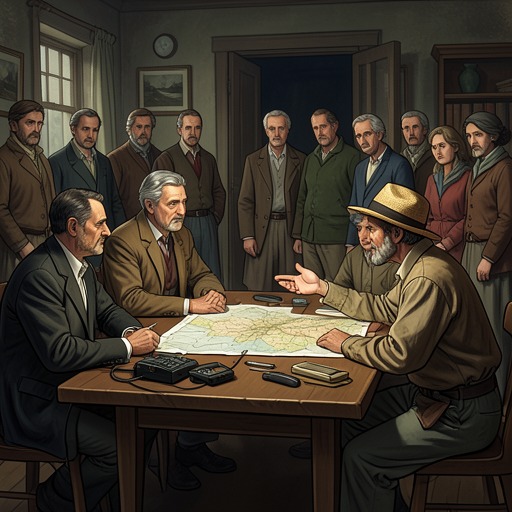
Antek does not receive this advice calmly. When the Blacksmith’s Wife reminds him that Boryna can withdraw the settlement during his lifetime, he turns pale and trembles as he works. Later, when the Blacksmith’s Wife and her husband visit to discuss the matter, Antek presses them to explain their purpose. The Blacksmith’s Wife raises the settlement; Boryna answers that he made it because he wanted to and could sign over everything if he chose. Antek counters that Boryna can do so only if the land is truly his. The exchange brings the dispute out of private calculation and into open confrontation.
The settlement inside the household crisis
The attempted negotiation takes place in Antek and Hanka’s home, where domestic life continues around the argument. Hanka sits at the threshold nursing her boy and watches Antek anxiously; Józka calmly peels potatoes and tends the fire, while the Blacksmith’s Wife tries to quiet the children. The settlement’s consequences are therefore not abstract questions of property. The argument unfolds among the people whose labor and security Antek believes are at stake, with Hanka directly present as his wife and partner in the claim.
When Antek declares that he, the others, and ultimately the court will stop Boryna, the proposed negotiation collapses into threat. Boryna springs forward with raised fists, and Hanka jumps up to insist that they will not allow him to wrong them. The deed has not resolved the family’s claims; it has sharpened them. Its existence gives Antek a specific grievance, but the effort to contest it also exposes how little a written settlement alone can settle when authority over the land remains disputed within the household.
Marriage, inheritance, and uncertainty
The settlement is kept in a chest as the wedding approaches. Jagna’s mother, Dominikowa, fears that Boryna’s stepchildren will feel aggrieved and seek vengeance, even as she believes that driving Antek’s family out has prevented a still greater offense. The banns have been posted, the hog slaughtered, and guests invited; the preparations make clear that the transfer is bound to a marriage already moving toward its public ceremony. Dominikowa resolves to protect Jagna, but her worries show that the land agreement has consequences beyond the two people who signed or contested it.
As presented in these scenes, Boryna’s land settlement is neither a neutral conveyance nor a final answer to inheritance. It attaches a substantial land grant to Jagna’s marriage while leaving room for Boryna to change course and for Antek’s household to advance competing claims. The Blacksmith’s Wife’s proposed witnesses and possible court action reveal how the dispute shifts between family custom, personal influence, and formal law. The document promises security to one household, threatens another, and turns the question of who owns the land into an argument about labor, kinship, and the authority to decide its future.